

Home > Company News
An occasional small anterior nosebleed often responds to proper compression. Recurrent or posterior bleeding is more difficult to localize and may involve greater blood loss. In posterior epistaxis, much of the blood may travel into the throat, so the nostrils can appear relatively dry while the patient repeatedly swallows, coughs up clots, or becomes nauseated. Older adults and people with cardiovascular disease, anticoagulant use, or a coagulation disorder may also tolerate blood loss and packing less well.
• Check mental status, breathing, pulse, and blood pressure and assess the possibility of ongoing blood loss or circulatory instability.
• Review anticoagulants, antiplatelet drugs, nasal medications, recent surgery, and previous hemostatic treatment.
• When appropriate, prepare a blood count, coagulation studies, crossmatch, and intravenous access as part of emergency care.
• Begin basic measures such as sitting forward and continuous compression of the soft nose; in heavy bleeding, the emergency team prioritizes airway and circulation.
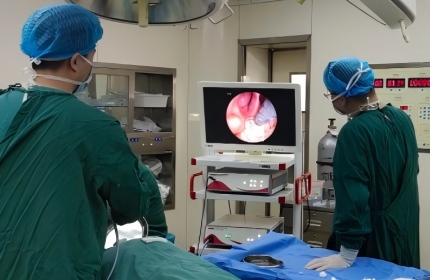
When bleeding continues after packing, repeatedly returns on the same side, or appears to arise posteriorly, endoscopy helps remove clots and inspect the posterior septum, posterior inferior meatus, middle meatus, nasal roof, and area near the choana. The clinician looks not only for active bleeding but also for an adherent clot, abnormal vessel, ulcer, bulge, or mass.
Repeated unilateral bleeding, especially with obstruction, facial pain, ear pressure, or unexplained anemia, should not be managed by packing alone. Imaging, tissue diagnosis, or vascular assessment may be appropriate depending on the examination.
A small identified source may be treated with a local hemostatic agent, limited cautery, or electrocautery. If the source cannot be found immediately, appropriate packing can provide temporary control, but pain, oxygenation, pressure injury, and continued posterior blood flow require monitoring.
When high-volume bleeding recurs despite local treatment, or endoscopy suggests a posterior arterial source, surgery such as endoscopic sphenopalatine artery control may be considered. Endovascular embolization is reserved for selected cases after imaging and multidisciplinary review. The choice depends on location, prior treatment, anesthesia risk, vascular anatomy, and available expertise.
Markedly elevated blood pressure can make hemostasis and observation more difficult, but hypertension is not the sole cause of every nosebleed. Anticoagulant or antiplatelet therapy must not be stopped by the patient without medical advice, because interruption may increase the risk of stroke, myocardial infarction, or thrombosis. The ENT team, emergency clinician, and original prescriber should balance bleeding and thrombotic risks together.
In thrombocytopenia, coagulation-factor abnormalities, liver or kidney disease, or inherited bleeding disorders, local control should be accompanied by correction of reversible factors and a follow-up plan.
• A large amount of fresh blood continues to enter the throat or does not stop with firm compression.
• Dizziness, sweating, palpitations, fainting, chest discomfort, or breathing difficulty develops.
• Sudden heavy bleeding follows recent facial trauma or nasal surgery.
• The patient takes an anticoagulant or has a known severe bleeding disorder.

+86-13167065777
Building 5A, No. 9628, Hunan Highway, Pudong New Area, Shanghai, China
 Links:
Shanghai Shiyin Photoelectric Instrument Co.,Ltd. All Right Reserved